Over the course of his career, Chris Rowland has established himself as a leading figure in securities services, working across a number of leadership roles at some of the industry’s largest players.
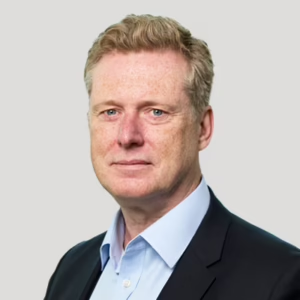 But if you ask Rowland himself, his early years working in other areas of the industry continue to shape how he perceives his professional identity today.
“I actually started my career on the tills in Southwark for NatWest,” he reflects. “Back in the day when we were still licking envelopes and putting statements in them. They had Böwes machines for cheque process, and I worked on proper wooden tills that had to be reconciled to the penny.”
It was a formative introduction. “Southwark at the time wasn’t what it is today; it was quite a challenging environment to work in. That’s where I really learned banking.”
After cutting his teeth at NatWest, Rowland moved on to what would be the first of two stints at JP Morgan – initially working in trader support within securities lending and cash management. Within 12 months, he had shifted into a more markets-focused role, where he worked for the next four years – an experience which left a lasting impression.
“It’s funny, because looking back I would never really have thought of myself as a securities services person, but I’ve now probably spent 70-80% of my career within that space. It’s interesting how you can have one perception of your career, while the reality is slightly different.”
A breadth of experience
Rowland’s switch to the securities services side came in November 2001, with a move to BNP Paribas where he became head of UK global relationship managers. In the role, he established a business development team for the UK and oversaw the set-up of the UK direct custody location.
Some 25 years later, Rowland remains firmly rooted in the securities services space. He now heads up the custody, digital and fund services business at State Street – a remit that mirrors the product-focused roles that have defined his career.
“What I do here is actually very similar to what I’ve been doing for the best part of 20 years,” he says. “I’ve worked in sales and relationship management, product management roles, large scale re-engineering programmes and operations. Other than technology and second line of defence, I think I’ve pretty much covered all of the bases.”
It’s a vantage point that he relishes. Product, he says, offers a 360-degree view of the business. “You get to touch everything that’s going on, all the different teams and people who contribute to delivering the service. I’ve always fundamentally enjoyed that type of work.”
When asked how that breadth of experience has helped to shape his leadership style, Rowland points to the importance of understanding other people’s perspectives.
“Having gone through that multitude of roles, you develop a perspective of where people are coming from. Because I’ve worked across and led teams over time, I understand and appreciate the pressures and challenges people are dealing with. One of the things that has helped me most is listening. I see myself as an active listener, and that’s been a consistent strength throughout my career.”
He also places particular value on some of the people he has worked alongside, noting how those relationships have too helped to shape his management style and understanding of the industry.
“I’ve been lucky enough to work with a number of the industry’s leading lights over my career and I think you learn a bit from everybody and that ultimately shapes you as an individual as well. You observe how they behave in different situations, how they make decisions, and you take pieces of that on board.
“I’ve worked with many people over my career, and some of them have gone on to do amazing things. I’m proud of whatever small role I may have played in their development.”
The only constant
Ask Rowland what constitutes a ‘good day’ at work, and the answer reflects the scope of his responsibilities. “A good day can mean a number of different things,” he ponders. “It might be having a productive conversation with a client and moving something forward, or solving a particular problem. It could be addressing a risk issue that needs attention, or responding effectively to a market event.”
That point is more pertinent than ever in today’s world, with no shortage of such moments. Geopolitical tensions, market volatility and regulatory shifts have demanded constant vigilance from Rowland and his peers.
“In this business, the only constant – other than change – is the speed at which you have to react to emerging issues,” he says. “The quality of that response depends heavily on how you’ve built and equipped your team, how you think about risk, and how well you arm your team and yourself with the right information and data to respond effectively.”
But while the headlines may feel relentless at times, Rowland views today’s challenges as part of a longer arc. “I don’t really think of things as entirely new,” he says. “It feels more like an evolution over the last 30 years that has simply accelerated. Much of that acceleration has been driven by technology.”
He traces that arc from the first access to email and the internet in the late 1990s to today’s debates around artificial intelligence. “Back then it was fundamentally about access to knowledge. Fast forward to today, and we’re talking about AI, whether that be generative or agentic. But again, it’s about knowledge – how you harness information and use it to speed up processes and improve decision-making.”
There have been inflection points. The global financial crisis stands out. So too does the current moment in AI. But in Rowland’s mind, they are chapters in a broader story of steady transformation.
Legacy and integration
When asked to reflect on his proudest professional achievement, Rowland is quick to move away from individual milestones and towards collective impact – with two initiatives standing out in particular: State Street’s recent integration work with Mizuho, and a similar initiative at JP Morgan in 2007-2008.
“What makes those stand out is that they fundamentally adjusted the strategy of the firms involved. They were critical in delivering new capabilities to clients. The earlier example created a foundation that supported growth for a very long period of time. And at State Street, we very much hope the work with Mizuho will achieve something similar.
“For me, the things that stand out most are the ones with real longevity. The decisions to enter new markets, to partner with new clients. And I guess those are the things you look back on towards the end of your career – the pieces of legacy you’ve left behind, and hopefully the company is slightly better off for having done them.”
Jump in with both feet
If Rowland could offer advice to his younger self starting out in this business, it would be simple: “If you’re presented with opportunities, jump in with both feet. If that means changing where you live, or changing the nature of what you do, don’t be afraid of it. Take the risk.”
He recalls a fork-in-the-road moment that came in the late 1990s, when he received similar advice that set him on the path that he’s now been on for the last 25 years. “I could have stayed in the markets environment and potentially gone in a completely different direction. Instead, I was encouraged to go and test myself; to take on a softer skill like sales in a business I knew nothing about – and that’s what I did.”
He adds that some of the earliest advice he received continues to shape how he works today: make sure you have the right risk control framework in your own mind and try to make effective decisions as quickly as you can.
Oh, and make your boss look good, he says with a smile. “That always helps.”