Could you talk us through your career journey and how you arrived at your current role at Pirum? 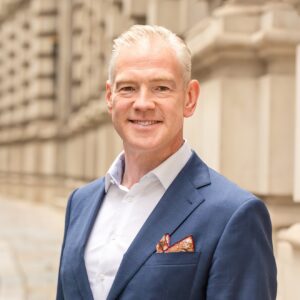 I started on the Goldman desk in 1999 as a securities lending trader, having come from HK with a technology degree, which at the time felt like the wrong qualification for a trading floor and turned out to be the right one. That combination has followed me everywhere since: close enough to the trade to know what clients actually need, close enough to the technology to know what’s possible.
From Goldman I went to Lehman in 2004 to run financing sales trading. Then 2008 happened – four good years building a business but then one bad. I was seconded into the administration of the estate with PwC, where six of us unwound the financing and prime book.
You learn more about how this industry really works in a default than in a decade of normal markets: what collateral is actually worth when everyone wants it at once, which infrastructure holds and which doesn’t, and who picks up the phone when it matters. A lot of the relationships I rely on today were forged in that period. The industry is small, and trust formed under stress doesn’t fade.
I moved with the business to Nomura and rebuilt prime finance there, then joined Pirum as COO in 2016. It was my first conviction bet that technology, not balance sheet, would increasingly drive the future of the industry.
JP Morgan pulled me back to the bank side in 2017 to run trading services globally, where we rebuilt the agency financing and triparty collateral business and built some of the early use cases on tokenised collateral.
Then I left banking once again and returned to Pirum, because having seen this industry from the markets side, securities services platform side, and the regulatory side, I’m convinced the next phase belongs to the connective infrastructure. Pirum sits exactly there. Coming back to lead it felt less like a new job than the logical continuation.
What does a “good day” at work look like for you? What are the moments that make the role most rewarding?
A good day is when a client tells us we’ve taken something off their plate they didn’t think could be solved – and the team did it without me in the room. The most rewarding moments are watching people grow into their roles, solving problems bigger than the ones they were hired for.
The product wins are satisfying, but the ones that stay with me are when someone on the team makes a leap in their career. This industry is small enough that you see the same faces for 25 years, so a good day usually also involves a conversation with someone I’ve known for most of that time where we both still manage to learn something.
What are some of the biggest changes and challenges you’ve witnessed in the industry throughout your career?
The shift from securities finance being a relationship-and-spreadsheet business to a data-and-capital business. When I started, the question was “can I do this trade?”, whereas now it’s “what does this trade cost me in capital?”.
Today, RWA and balance sheet efficiency drive desk behaviour in a way they simply didn’t a generation ago. The challenge that comes with it is fragmentation: more venues, more collateral types, more regulatory regimes, and no single source of truth.
T+1 in the US sharpened all of it, and Europe is next. And the enduring challenge hasn’t changed in 25 years: everyone agrees standardisation and automation are good, but everyone wants someone else to go first.
What are your current priorities as CEO of Pirum?
Three things. First, accelerating the Complete Connected Lifecycle offering. Driving adoption of automation that spans pre-trade, post-trade and collateral, because the value compounds when those connect rather than sit in silos.
Second, turning Pirum’s proprietary data into genuine intelligence, helping clients see liquidity, sourcing pressure and collateral cost in ways the public market can’t. Third, people: building a leadership team and a culture that can carry the next phase of growth, and raising the bar on delivery, because predictability matters as much as ambition.
Underneath all of it is one belief: the firms that win over the next five years will treat cost efficiency and technology as a single problem, and we intend to be the platform that makes that easy.
What would you say is your proudest professional accomplishment, and why?
Three things, and they’re related.
The first is the Lehman unwind. Not a comfortable thing to be proud of… but delivering for the creditors in the middle of the worst dislocation the industry had seen and seeing the post-trade infrastructure either hold or fail in real time shaped how I’ve thought about resilience ever since.
The Tokenised Collateral Network (TCN) at JP Morgan. From taking a vision of how tech evolution can impact the market, designing a product, getting approval (both investment approval and regulatory approval), to bringing the product live gives a wonderful sense of achievement, especially now, given the amount of activity in tokenisation in the collateral and funding perspective.
The final one – and the one I’d put first – is the people. The thing that lasts isn’t any single product or record year, it’s that there are teams and individuals across this industry, at banks, agents and Pirum, who I helped grow and who are now running things better than I could. The franchises I helped build have been rebuilt by them. That outlives any title.
If you could go back to the beginning of your career, what advice would you give your younger self?
Be more patient with people and less patient with problems. Early on I had those the wrong way round. The relationships you build in your 20s are the ones you’ll be doing business with in your 50s, so invest in them as people, not as contacts. And don’t mistake activity for progress; the busiest version of you is rarely the most effective.
What is the most valuable piece of advice you’ve ever received?
Someone early on told me the transaction is the easy part – the relationship is the asset. They told me ‘to try to know everyone, not everything‘. Twenty-five years on, every time I’ve seen a deal or a crisis tested, that’s held true.