
Olivier Minaire
SS&C has had a home in Luxembourg for more than a decade, but its new office marks the first time its alternatives and retail businesses have shared an address.
The new site, at 5 Rue Jean Monnet, officially opened on 15 October. The expansion comes as private markets growth pushes alternatives and retail fund servicing closer together, and Luxembourg to the centre of both.
The new office brings together SS&C (Luxembourg) SARL, the alternatives arm operating under SS&C GlobeOp, and SS&C Administration Services Luxembourg S.A. The retail transfer agency business joined the wider group after SS&C and State Street ended their International Financial Data Services (IFDS) joint venture in October 2025.
SS&C’s alternatives business in Luxembourg supports 57 clients and over $100 billion in assets, including committed capital, across more than 450 funds, sub-funds, umbrella structures and SPVs. The retail business brings $360 billion in assets under administration, more than 380 funds, over 4,500 share classes and 2.2 million transactions, run on an operating model delivering 97% straight-through processing.
“It’s more than an office opening; it’s a vote of confidence here in Luxembourg,” Stacey Feinberg, US ambassador to Luxembourg, told guests at the opening event.
On paper, the move brings two businesses under one roof. Strategically, it brings together SS&C’s alternative and retail fund servicing capabilities as those markets increasingly converge, giving clients access to a broader set of capabilities as they develop and distribute investment products in Luxembourg.
A new chapter
SS&C has had a presence in Luxembourg since 2013, and growth there has been anything but modest. “We’ve been growing here in Luxembourg 20 to 30% per annum for the last five to six years,” says Bhagesh Malde, SS&C GlobeOp general manager.
While growth is only part of the story, the firm’s executives point to several other factors behind the decision to expand now.
The first is a change to its transfer agency business. “Our presence here has really been via IFDS, which was a joint venture with State Street,” says Nick Wright, general manager of SS&C Global Investor & Distribution Solutions. “We dissolved the venture a year ago, and that’s given us the opportunity to go on our own.”
Bringing the two businesses together has also meant a move to larger premises, with room to grow.
SS&C has also broadened what it can offer clients in Luxembourg. “We’ve also brought out some new products and services. We now do corporate secretarial, and we just got a depositary light licence here, which allows us to offer custody services that we didn’t have before,” says Bill Stone, founder, chairman and CEO of SS&C. The licence, granted a couple of months ago, is a specialised depositary licence covering physical assets.
“The more we can meet with the regulator and with what Luxembourg wants overall, the faster we can deliver services and the more attractive we can make Luxembourg,” Stone adds.
Location, location, location
Luxembourg occupies a unique position at the centre of the European investment fund industry. For SS&C, the case rests on a simple observation: whoever the manager and wherever they sit, the investment vehicle increasingly ends up here.
“As we’ve seen the private markets industry grow rapidly over the last 10 to 15 years, Luxembourg has gained dominance in Europe as the domicile of choice for our clients’ vehicles,” says Malde.
“Whether they’re American firms, Asian firms or European firms, they’re picking Luxembourg for most of their vehicles.”
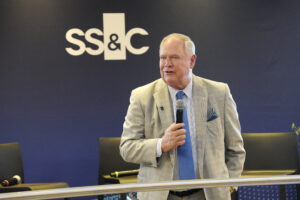
Bill Stone, Olivier Minaire
He attributes this to three factors: access to talent from neighbouring Belgium, France and Germany; first-class infrastructure; and authorities who are “more flexible than some of the other jurisdictions, a bit more business friendly, and have adapted their regulations quickly as the industry has changed”.
One quirk of the market, Malde highlights, is on the alternatives side, where the managers themselves are largely absent. “The managers are not here, but they pick Luxembourg as a good jurisdiction to have funds and raise money, and the investors are comfortable putting their money into Lux structures,” he says.
On the retail side, the picture is different. Wright says a decade ago, managers would fly in and out to oversee their Luxembourg fund ranges, but updated regulation means many now have a permanent presence in the country. “A lot of our asset management clients have people on the ground here now,” he says.
Luxembourg’s position is not unassailable, however, with Ireland a particularly strong rival for EU fund business. “If they’re not Lux structures, they’re Irish structures, and if they’re not Irish structures, they’re offshore structures,” says Stone. “There is constant competition.”
With significant pools of wealth at stake, Stone sees the contest as one fought on regulation, tax and openness to foreign capital. “There’s a lot of wealth, and generational wealth,” he says. “It’s a competition around who can make their regulatory regimes, their taxing regimes and their acceptance of foreign money the most attractive.”
For SS&C, there is little doubt about which jurisdiction is currently leading. “Luxembourg is winning that contest right now,” says Malde.
Servicing private markets
On the alternatives side, growth has been driven by private markets and, more recently, by private credit. “More and more institutional investors are looking for that private markets exposure,” says Malde.
That growth creates several operational challenges for managers, because private assets are much harder to service than public ones.
With private credit, Malde explains, each loan has to be underwritten, the agreements are rarely standardised, and the data has to be extracted from each one and monitored over time.
Valuation is a particular difficulty, since there is no market price to refer to. “You can’t go to some pricing service, so you have to have either your own models or work with a modelling company to come up with a defensible price,” says Malde.
Stone notes that this also explains one of the asset class’s perceived strengths. “One of the things the market likes about private loans is they seem not to have much volatility,” he says. “But they don’t have much volatility because they don’t get marked every day.”
The same data challenge applies across other private asset classes, including infrastructure. “Over the last 10 years we’ve seen big increases in infrastructure investing,” says Malde. “Wind farms, solar farms, data centres — the data in each case is different. If you’ve got a wind farm with thousands of turbines, collecting that data from each one of them is a real challenge.”
At the same time, investors are asking managers for more information. “There is some competition between managers to give investors the best experience and the best quality information they can,” Malde says. “On the private side, it’s a challenge to get to that data. That’s an area where I don’t see things slowing down.”
Technology can speed up data extraction and check for consistency, Malde says, “but it’s not fully replacing humans right now”.
Transfer agency as a differentiator
On the retail side, Wright’s argument starts with the competition. In Luxembourg, most transfer agency providers are banks.
“Transfer agency is not core to what they do; it has always been a little bit of a bolt-on for others,” he says. “Asset managers with Lux funds, and Irish funds as well, are underserved by the market. Through our 40 years, where we see a market segment is underserved, that’s where we tend to step in and add value.”
“Ask anyone with a Luxembourg fund range, or their distributors, about their biggest pain point, and the answer will be KYC and AML,” Wright says, “Here too, he sees an advantage in SS&C not being a bank: where a bank-owned transfer agent applies the KYC and AML standards set by the bank and its regulators, SS&C can work to the asset manager’s specific risk appetite, above its own minimum standard.
The other half of the equation is how managers want to engage with their investors, and the answer varies. “Some of our clients really want us to be on the phone talking to their clients all the time. Others will say the less they’re on the phone the better, the more we can do digitally,” says Wright.
The same is true of products. As Luxembourg managers push beyond traditional UCITS into ETFs, digital assets and tokenised funds, Wright says SS&C’s role is not to pick winners. “We believe in digitisation, we believe in tokenisation, but we still have people who like to send cheques in or want to be on the phone — and that’s absolutely fine.”
He admits the investment case for tokenisation is a long game. SS&C expects to generate revenue of around $6.7 billion to $6.8 billion this year, and “not much of that is down to tokenisation. But in 10 years’ time it will be – and it won’t be unless you start investing in it now.”
Ultimately, Wright says, the industry has a simple problem to solve. “If you decide to buy a book or a film, that’s the easiest thing in the world. If you want to invest in a fund, it’s complicated. It shouldn’t be complicated.”
Two worlds under one roof
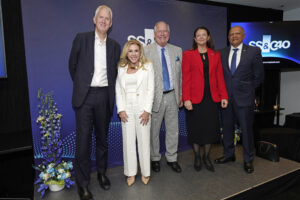
Olivier Minaire
SS&C is focused on serving markets moving closer together, as alternative investment managers look beyond institutions to individual investors. “I tend to focus more on the traditional fund structures and Bhagesh is more on the alternative fund structures, but those two worlds are coming together,” says Wright. “Luxembourg is doing a pretty good job of putting itself at the forefront of that.”
Malde says SS&C is already seeing that demand from clients. “We’ve got a lot of clients who are interested in raising retail vehicles here in Luxembourg,” he says. “We’ve already got big North American managers – US and Canadian managers – asking us how we can collaborate on putting something together for Luxembourg.”
Stone warns selling retail alternatives to individuals carries risks. “It’s one thing to sell alternatives to institutions. It’s another thing to sell them to individuals,” he says. “If you’re not careful, you’ll sell it to some individuals who don’t know what they’re going to do – and then all of a sudden you’ll see gates.”
Malde expects regulators to focus on investor protection, and managers to take more responsibility for educating investors. “The managers will have to step up their game to do that, not just take the money,” he says. Even so, he does not expect demand to slow. “Investors want more alternatives exposure in their portfolios, and they’re encouraged by their investment advisers. I don’t think the trend is going to stop.”
‘Customer Zero’
Asked what sets SS&C apart, the executives return repeatedly to the fact that the firm develops and runs its own technology.
Malde, who ran hedge fund servicing at JP Morgan and private markets at State Street before joining SS&C, says this was what drew him to the firm. “At the two firms I worked at before, we were good in the business, but we never controlled the technology,” he says.
“Wrapped around the services, we’re a technology company,” says Wright. “We bring strong technology to the table.”
Stone says this matters more as volumes increase, with some of SS&C’s hedge fund clients processing five to 10 million trades a day. “Remember, there’s five or 10 million more coming tomorrow, and the next day, and the next day,” he says. “You have to make sure your systems are very powerful and fast, but also very resilient.”
The firm was also an early adopter of newer technology: Malde says SS&C began using large language models in its alternatives business in 2018, “even before people called it AI”, initially to track and monitor private credit loans.
In 2022, SS&C bought Blue Prism for $1.6 billion after concluding automation was about to change the industry. “SS&C is not a firm that dabbles,” Stone says. “We’ve deployed 3,500 robots in our business.”

Olivier Minaire
He does not see AI agents replacing those bots, explaining that a bot can handle around 80% of a reconciliation and an agent the remaining 20%. “You don’t have to take this massive investment you’ve made in bots and throw it away.”
SS&C’s own servicing businesses are the first to use the technology it builds or acquires. “We’re the biggest consumer of our technology, and that’s why we call ourselves Customer Zero,” says Malde. “When we go out into the marketplace with a new service, a new product or new technology, we’ve already tested it in our own operations.”
As the market grows more complex, the executives argue this will become a greater advantage. “We have the potential to differentiate ourselves further from our competitors, because we think our capabilities are stronger,” says Malde.
The view from here
When asked what comes next for SS&C in Luxembourg, each executive pointed to a different part of the picture.
For Malde, there is little doubt about the next big thing for Luxembourg. “I think retail is probably the next big thing coming here,” he says, though he does not expect it to be a one-horse race. “I don’t think Ireland is going to let them have it all. So there’s going to be some competition for those assets, and that’s good.”
With teams in both jurisdictions, SS&C has covered its bases. “We’ve got 500 people in Ireland and a couple of hundred here, so we’re pretty well positioned whichever way it goes,” says Malde.
Stone, 40 years after founding the firm, is already looking beyond the current wave of technology. “In two years, maybe three years, all you’re going to be hearing about is quantum, and everybody’s going to forget about AI,” he says. When that happens, he adds, everything we know now will look “really slow”.
Wright acknowledges much of what comes next is uncertain. “The most exciting bit is none of us know,” he says. What is clear, in his view, is the importance of Luxembourg itself. “Luxembourg increasingly is the entry point for investors all around the world into the asset management industry.”
These trends shape how SS&C organises itself, with people positioned where funds are domiciled and where they are sold, from Germany and Taiwan to Singapore, Australia and Brazil. “We look at it from two perspectives. One is where is the product domiciled, and that’s Luxembourg. The other is you’ve got to be close to your end client and the people that are advising them,” says Wright. “If our clients are here, we need to be here.”
In the end, he says, it comes down to one thing: “Our job is to provide the optionality.” And as Feinberg told the room on opening night: “Luxembourg has what it takes.”